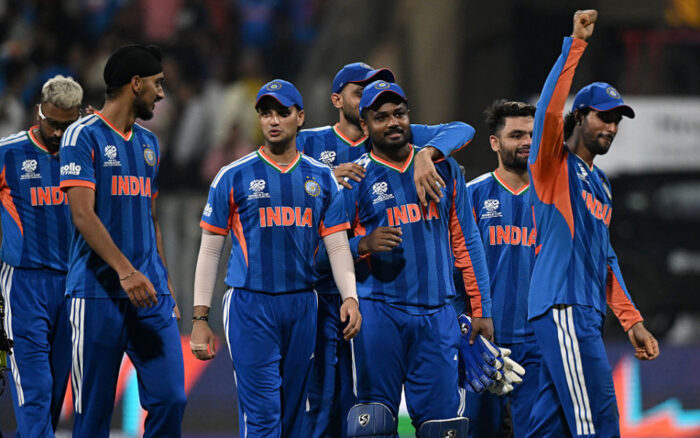
The atmosphere at the ground was thick with a tension that only a knockout match between these two giants could produce. On paper, it was a semi-final; on screen, it felt like the high-stakes climax of a sports blockbuster. India, fueled by a billion dreams and the stinging memory of past heartbreaks, took to the field with a clinical intensity that bordered on the cinematic. Every boundary felt like a plot twist, and every wicket was met with a roar so deafening it could have served as the film’s crescendic score. England, the defending champions with their own brand of aggressive flair, played the perfect antagonists, refusing to go down without a fight in a battle of nerves and skill.
The “turning point” arrived with the kind of poetic timing usually reserved for scripted dramas. Just as the momentum threatened to shift, India’s maestros took control of the narrative. Whether it was a captain’s knock that defied the tricky surface or a spin masterclass that left the world’s best batters searching for answers, the performance was a masterclass in redemption. The camera pans on the fans—faces painted in saffron, white, and green—captured the raw, unscripted emotion of a nation holding its breath. It wasn’t just about cricket; it was about the hero’s journey, overcoming the ghosts of semi-finals past to reclaim dominance on the world stage.
As the final wicket fell, the celebration felt like the closing credits of a masterpiece. The images of players embracing, some in tears and others in jubilant disbelief, mirrored the relief and joy of an audience that had waited years for this specific victory. England’s exit was dignified, marking the end of an era, while India’s progression felt like an inevitable march toward destiny. It was a match defined by “box office” moments—stunning catches, tactical gambles, and sheer willpower—proving once again that in the world of sport, reality is often more compelling than any script Hollywood could ever conceive.
India’s Fearless Start Sets the Tone for a Massive Total
From the very first ball, India’s openers stepped onto the crease not with caution, but with a clear mandate to dismantle the bowling attack. There was an audible shift in the stadium’s energy as the first boundary pierced the infield—a statement of intent that signaled the “safety-first” approach of yesteryears had been firmly retired. By taking the fight to the opposition’s quickest bowlers, India turned the powerplay into a highlight reel, treating world-class deliveries with a disdain that bordered on the theatrical. This wasn’t just scoring; it was a psychological siege that left the fielding side scrambling for answers before the game had even settled.
The beauty of this fearless start lay in its calculated aggression. Rather than swinging blindly, the batters utilized elite hand-eye coordination and nimble footwork to exploit every gap, ensuring that even the “good” balls were punished. This relentless pressure forced the bowlers to deviate from their plans, leading to a cascade of wides, no-balls, and defensive field placements. Each towering six served as a building block for a mounting total, creating a sense of inevitability. As the run rate climbed into the double digits, the foundation for a massive score was laid, providing the middle order with the luxury of time and the cushion of a soaring scoreboard.
By the time the initial fielding restrictions were lifted, the damage was more than just numerical; the opposition’s morale was visibly dented. The aggressive tempo set at the top of the order acted as a catalyst for the entire innings, transforming the pitch into a playground for the incoming batsmen. It set a benchmark that demanded excellence from every subsequent player, turning a standard match into a relentless pursuit of a record-breaking tally. This proactive philosophy didn’t just set the tone for a massive total—it redefined the expectations of what a modern batting powerhouse looks like in full flight.
Sanju Samson Ignites the Stadium With a Blazing Knock
When Sanju Samson walked out to the middle, the atmosphere shifted from expectant to electric, as if the crowd collectively knew they were about to witness a masterclass in timing. From his very first scoring shot—a signature back-foot punch that raced to the boundary—it was clear that Samson wasn’t just playing a game; he was painting a masterpiece. His batting possessed a rare, effortless elegance where even his most violent hits looked like a gentle extension of his follow-through.
As the ball repeatedly disappeared into the upper tiers of the stands, the stadium transformed into a cauldron of noise, fueled by the sheer audacity of a man who makes the most difficult strokes in cricket look like a walk in the park.
The “Samson Show” wasn’t just about the volume of runs, but the demoralizing precision with which they were delivered. He didn’t just target the boundaries; he dismantled the bowlers’ confidence, meeting 150 km/h deliveries with a still head and a high elbow. Whether he was dancing down the track to loft a spinner over extra cover or launching a pull shot that seemed to defy the laws of physics, his strike rate climbed into the stratosphere.
Every six felt like a personal statement of intent, a reminder that when Sanju is in this “flow state,” the fielders are merely spectators with the best seats in the house. The scoreboard whirred with a dizzying speed that left the opposition captain frantically shuffling his deck, yet finding no card to trump Samson’s brilliance.
By the time he finished his blazing cameo, the damage was etched into the weary faces of the bowlers and the jubilant faces of the fans. The knock served as the ultimate accelerant, turning a competitive total into a mountain that looked impossible to climb. As he walked back to the pavilion, the standing ovation was a tribute to a player who prioritizes the soul of the game as much as the statistics. It was more than just an innings; it was a fire-starting performance that ignited the spirit of the team and the imagination of the crowd, leaving an indelible mark on the match that no highlight reel could truly capture in full.
England’s Bowlers Struggle as Boundaries Flow Freely
The English bowling attack, usually known for its tactical precision and “Bazball”-era aggression, found itself completely adrift as the Wankhede Stadium transformed into a graveyard for bowlers. From the opening over, the lines were too wide and the lengths too predictable, allowing the Indian openers to set a blistering tempo that never subsided. Even the most seasoned campaigners in the English ranks struggled to find their rhythm, as the dew factor and a lightning-fast outfield turned every miscalculation into a boundary. It was a rare, vulnerable display from a world-class unit that seemed to have no answer for the relentless assault.
As the middle overs approached, the struggle transitioned from tactical to psychological. England’s premier spinners, who usually thrive on building pressure, were repeatedly hoisted over the ropes, unable to find the grip or turn needed to stem the flow of runs. The sight of Jofra Archer—usually the epitome of calm—conceding 61 runs in his four overs was the ultimate testament to India’s dominance. Every change in pace was read with surgical precision, and every “death-over” yorker that missed its mark by an inch was dispatched with disdain, leaving the English fielders chasing shadows in the Mumbai heat.
By the time the final overs arrived, the English bowlers looked visibly weary, their shoulders slumped as the boundary count reached record-breaking levels. The sheer frequency of the hits—37 boundaries in total—meant that the pressure never eased, forcing the captain into a defensive mindset far earlier than anticipated. It wasn’t just a bad day at the office; it was a total systemic breakdown where the plan to “contain” was replaced by a desperate attempt to simply “survive.” This bowling performance left the English batters with a mountain to climb, a target of 254 that would require nothing short of a miracle to chase down.
The English Fightback: A Counterattack Led by Jacob Bethell
Just as the match seemed to be slipping away into a one-sided affair, young Jacob Bethell stepped onto the stage to flip the script, turning a desperate chase into a genuine thriller. With the veteran stars back in the pavilion and the required run rate climbing toward the impossible, Bethell played with a fearless maturity that belied his age. He didn’t just survive the Indian spin trap; he dismantled it, using a series of audacious reverse sweeps and lofted drives that forced the field to scatter. Each boundary he struck acted as a spark of hope, reigniting the English dugout and silencing a stunned crowd that had, until then, been celebrating a premature victory.
The brilliance of Bethell’s counterattack lay in his ability to disrupt the rhythm of India’s premier bowlers. While the world-class attack tried to tighten the noose with yorkers and subtle changes of pace, Bethell remained unfazed, finding gaps with surgical precision. His footwork was a masterclass in modern batting—stepping deep into his crease to punish short balls and dancing down the track to meet the flighted deliveries before they could turn. This wasn’t just a desperate slog; it was a calculated assault that shifted the psychological pressure back onto the bowling side, proving that England’s “never-say-die” philosophy remains vibrant in its next generation of talent.
By the time Bethell’s whirlwind knock for England reached its crescendo, he had transformed the complexion of the game from a certain defeat into a frantic finish. The momentum he generated was infectious, allowing the lower order to swing with renewed confidence as the scoreboard pressure began to weigh heavily on the Indian fielders. Though the mountain remained steep, Bethell’s defiance ensured that England went down swinging, providing a cinematic “fightback” sequence that added a layer of grit to the semi-final drama. His performance served as a loud announcement to the cricketing world: a new star had arrived, capable of standing tall even when the lights were brightest and the stakes were at their highest.
Middle-Overs Battle: India’s Bowlers Turn the Pressure Up
As the middle overs commenced, India’s bowling unit executed a tactical squeeze that felt like a masterclass in atmospheric pressure. While England’s Jacob Bethell was threatening to run away with the game, India’s spinners and change-of-pace specialists began hitting a “heavy” length that made free-flowing strokeplay nearly impossible.
The roar of the Wankhede crowd acted as a twelfth man, mounting the psychological burden on the English batters with every dot ball. It was a period defined by elite discipline; even when boundaries were conceded, the bowlers refused to stray from their plans, slowly but surely sucking the oxygen out of the English chase and forcing the set batters into high-risk maneuvers.
The defining image of this defensive masterclass was a moment of pure, unadulterated fielding genius from Axar Patel. When Will Jacks launched a wide full-toss toward the deep point boundary, it looked for all the world like a certain six that would keep England in the driver’s seat. Instead, Axar sprinted along the ropes like an Olympic 100-meter specialist, plucked the ball out of the air while airborne, and—realizing his momentum would carry him over the cushion—flicked the ball back to a stunned Shivam Dube.
This “relay catch” was a cinematic masterpiece of awareness and athleticism; it didn’t just dismiss a dangerous batter, it physically manifested the “fearless” spirit India had carried all day, effectively breaking the back of the English resistance. By the time the final overs approached, India’s middle-over surge had turned a runaway train back into a mountain climb. Axar’s brilliance in the field was mirrored by his work with the ball, as he consistently found the “skid” and “turn” necessary to keep the England lower order guessing.
The combination of Jasprit Bumrah’s surgical precision and the spinners’ control meant that for every spectacular hit England produced, India had a tactical counter-punch. This phase of the game proved that while big totals win headlines, it is the gritty, high-pressure execution in the middle ten overs—and the moments of individual magic in the field—that truly decide the fate of a semi-final.
Momentum Swings and Crowd Roars in a Classic T20 Contest
The Wankhede Stadium wasn’t just a venue; it was a living, breathing character in this semi-final epic. Every time the ball soared toward the stands, the 33,000-strong crowd erupted in a sonic boom that seemed to physically push the momentum in India’s favor. These “roars” became the heartbeat of the contest—deafening when Sanju Samson was clearing the ropes, and dropping into a pin-drop silence during Jacob Bethell’s defiant century. The atmosphere oscillated between euphoria and anxiety, mirroring the frantic swings on the scoreboard as the two giants traded blows in a high-octane 499-run festival.
The pendulum of momentum swung most violently when England’s chase threatened to turn the “impossible” into reality. For a few heart-stopping overs, Bethell’s fearless hitting silenced the drums, making the massive target of 254 feel suddenly vulnerable. However, in a classic T20 twist, a single moment of fielding brilliance or a dot ball from Jasprit Bumrah would reignite the stands, sending a wave of energy back to the bowlers. This constant tug-of-war between bat and ball, punctuated by the rhythmic chants of the fans, created a cinematic tension that only a knockout match of this magnitude can produce.
Perhaps the loudest roar of the night was reserved for the defensive masterclass led by Axar Patel’s “superman” efforts. When he plucked the ball from the sky to dismiss England’s captain Harry Brook, the stadium nearly shook off its foundations. It was the ultimate momentum shifter—a visual representation of India’s refusal to let the game slip. As the final overs ticked down and the pressure reached its boiling point, the crowd’s energy became an insurmountable wall for the English batters. In the end, the victory belonged as much to the fans’ unyielding spirit as it did to the players’ tactical execution, cementing this match as a forever classic in the T20 archives.
India Storm Into the Final of the ICC Men’s T20 World Cup 2026🏆
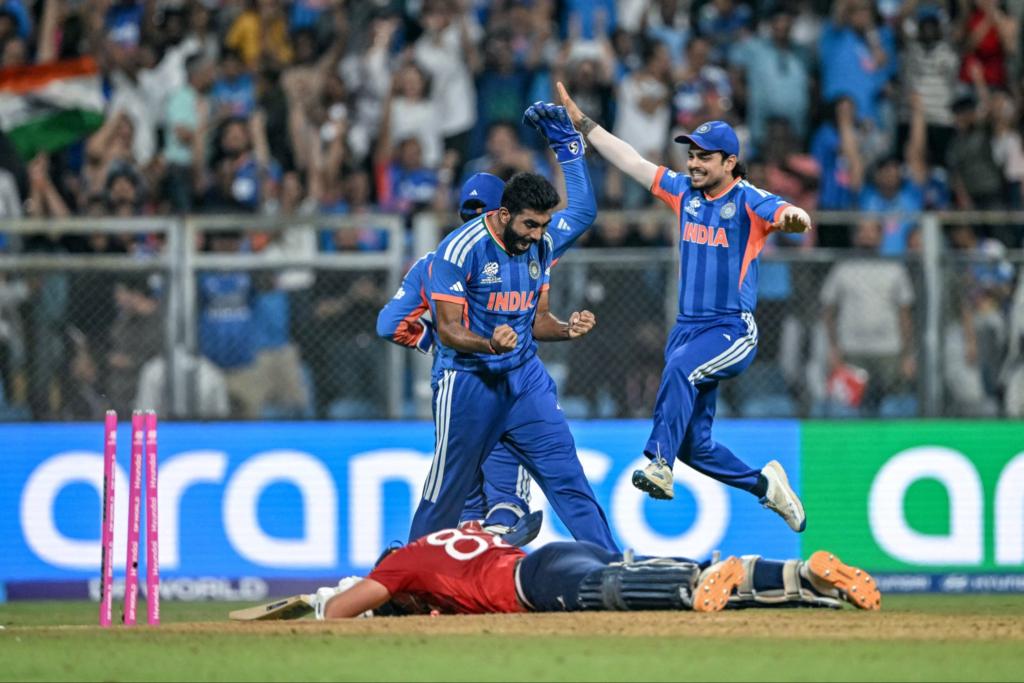
The final wicket—a desperate run-out of the centurion Jacob Bethell—sparked a scene of pure delirium at the Wankhede Stadium. As the bails lit up, the realization set in: India had held their nerve in a 499-run thriller to secure a seven-run victory and a spot in their second consecutive T20 World Cup final. The defending champions didn’t just win a game; they survived one of the greatest counter-attacks in tournament history. For the fans draped in blue, the tension of the last few overs dissolved into a roar that could be heard across Mumbai, marking the moment India officially became the first team in history to reach four T20 World Cup finals.
This journey to the summit clash was paved by a record-breaking batting performance that rewrote the history books. India’s massive total of 253/7, fueled by Sanju Samson’s magisterial 89 and explosive cameos from the middle order, was the highest ever recorded in a T20 World Cup knockout match. It was a display of “Total Cricket” that combined fearless intent with surgical execution. Despite England’s valiant chase, the disciplined death bowling of Jasprit Bumrah and the tactical acumen of Suryakumar Yadav ensured that the mountain India built was just a few inches too high for the challengers to scale.
Now, the road leads to Ahmedabad, where a blockbuster final against New Zealand awaits at the Narendra Modi Stadium. India stands on the precipice of immortality, aiming to become the first-ever host nation to lift the trophy and the first to successfully defend a T20 World Cup title. The momentum from this “movie-like” semi-final has transformed the team from contenders into an unstoppable force. As the players celebrate under the Mumbai lights, the message to the world is clear: the champions aren’t ready to give up their crown just yet.
Discover more from Sporty Vaibhav
Subscribe to get the latest posts sent to your email.